

The true cost of visas - our parliamentary report launch

The true cost of visas - our parliamentary report launch
26.05.2026
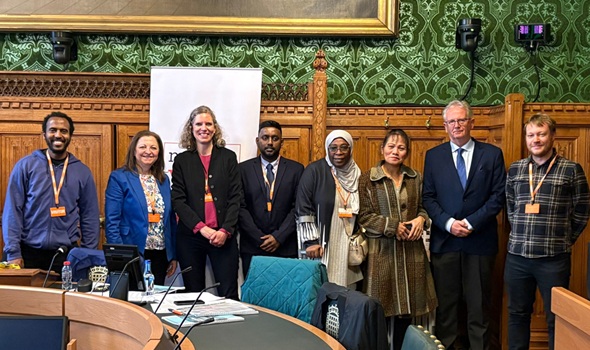
Migrant Voice launched its new report in parliament on 19 May as part of our campaign to reduce extortionate visa costs and work for shorter settlement routes.
Starting with a rally in Parliament Square, we moved to Parliament for an event hosted by Pete Wishart MP and chaired by Seamus Logan MP.
A series of powerful speakers shared how the system is operating, its cruel and unnecessary impact and their calls for change. Together we said it loud and clear - why the whole system and the underlying attitudes and systems need to change.
Anne Stoltenberg from Migrant Voice presented the findings from our report, The True cost: the financial, social and mental health impacts of the UK visa and settlement system, which shows how the cost of visas puts a strain on the lives of innumerable migrants and their families. This impacts everything from debt to financial hardship, compromising on housing, struggling to pay rent and bills, and cutting back on food but it also impacts on mental health, the ability to plan and on family life. The full report and findings can be accessed here.
The real-life impact of the current system was highlighted by all the speakers:
Nazek Ramadan, Director of Migrant Voice shared how the campaign had started and said that “migrants are penalised for wanting to make a life here. In this hostile environment and divisive rhetoric, people tend to forget that migrants are just partners, workers, students, their families… Migrants are impacted by external factors, such as cost of living, the pandemic, but unlike everybody else, migrants still have to foot huge bills to pay for the visa fees. So, this is why we're here.”
Nick Beales, Head of Campaigning, Refugee and Migrant Justice, set the legal and policy context. He explained that for each visa renewal, a family of four currently pay £14,683 and they must apply 4 times on the 10-year route. Then at the end of that process, they’d have to pay another £3,224 each for Indefinite Leave to Remain. The whole process would cost around £70,000 for a family of four.
Nick spoke to the concern felt by many of the proposed extension to settlement routes. “Worryingly, the government intends to introduce a so-called “earned settlement model” that will extend settlement routes for many people … to 15 or even 20 years. For example, people who receive public funds to which they’re entitled will be punished with an additional 5 or 10 year qualifying period.”
Keziah Gitonga, steering group member for the Migrant Voice campaign powerfully shared the impact on her family: “Picture this: you fall in love, you get married, you think the hard part is over, then the home office sends you a fee invoice, and suddenly love has a price tag, not just once, every two and a half years... Love is not cheap anywhere, but in Britain, apparently, it comes with an administration charge.”
“There's a quiet kind of grief in building a marriage around these renewals, in knowing that your relationship, your love, is subject to administration approval, in explaining to family why you cannot visit, in watching savings you both worked for disappear into Home Office fees again and again and again... and all this while the media frames people like my husband as a burden, as a problem, as a number in a hostile headline.”
The next speaker, Sachintha Hetti Thanthiri, Co-founder of the Skill Migrants Alliance Limited shared the concerns raised about the impact of financial pressures and of fear, stress and anxiety, but also in the workplace where some feel unable to speak up about unfair treatment because their visa depends on sponsorship. “We have heard concerns about unpaid extra hours, pressure to accept difficult conditions, sudden reduction of working hours, and fear of losing sponsorship if they complain.”
A particular concern for the Skill Migrants Alliance is the proposed extension to settlement routes and that they may be introduced retrospectively. “Many migrants made important life decisions based on the rules that existed at the time they came to the UK.”
“Our members have also reached out to us about the impact on children. Some parents say their children ask difficult questions like, ‘Will we have to leave the UK?’ Many children were born here or have spent most of their lives here. Parents worry about their children’s … future because of ongoing immigration uncertainty.”
Esther, a long-term activist on the impact of visas and settlement routes shared the impact of the ten-year route to settlement. She has had to pay £18,000 for visas for herself, her partner and four children. Two of her children are now British, but the last visa renewal cost for them and herself, and her partner still came to £14,000 pounds.
Esther raised the issue of the delays in getting a decision and how it impacts on employment. Although one’s status should officially continue while waiting for a visa, many employers are cautious and don’t follow this.
“I am very good at my job, but for the past five months I can't do anything. You can imagine the financial cost it has on me, and the kids asking me, Mommy, why are we eating the same thing every day. Why the same breakfast? Then I tell them it's full of fibre, it will make your tummy full when you get to school. How do I explain to them that it's because Mommy's not working, because I've paid enough money [for the visa], sometimes I have to choose between healthy meal or not, you know, the basic things that are supposed to be there … and so that gives me anxiety, because I'm not giving my children the quality of life they desire. I want to do the best that I can do for them.”
Esther made it very clear that there is a practical alternative – reducing visa fees to administrative costs only and reducing the International Health Surcharge. She spoke about the unnecessary delay of the decision making on the repeated renewal. “I am not new to the system. You have my documents, you have everything on the system, so why wait 12 months, and in the course of waiting, I'm not able to work.”
Fidelis Chebe, Chief Executive of Migrant Action and Holly Mogford from Swansea University presented the preliminarily findings from a collaborative doctoral research project titled “Immigration Control as a Revenue Regime.”
Fidelis prefaced the report findings by sharing how at Migrant Action they see every day the impact of policy on individuals but are also wanting to root their work in a more structural, systemic analysis. “Because these are not arbitrary happenings, there's a system, and there's a structure that is sustaining this, and this is what the research will show.”
Fidelis explained what he called the triple lock system of the visa fees. People are locked in a system of generational trauma. People are also locked in a system of extraction… whether it's the Home Office or employers or landlords… and the last dimension is people are locked in a system of immigration enforcement.”
Holly gave an overview of the research with individuals across Yorkshire and South Wales which shows the harm of the visa and settlement routes but also how it doesn’t operate in isolation as individual must navigate a range of immigration charging regimes, including visa settlement and citizenship fees, the Immigration Health Surcharge, together with employer sanctions and landlord sanctions. This is exacerbated by the broader immigration system, for example, No Recourse to Public Funds.
Holly highlighted the preliminary findings of the research. “The first is that extraction is a significant feature of migrant life. Second, harm deepens as the regimes compound, and finally, migrant life is controlled in part through charging regimes.” She shared several case studies from the research and explained that this research sees extraction as both financial and emotional: “as people move through the system, such extraction turns into exhaustion, in which survival must be practised daily. “
One of the ways in which migrant lives are controlled through this system of charging, is control of time: “when determined by the Home Office, time is rigid, but when it comes to waiting for applications outcomes, time is uncertain, with one participant describing the settlement process like a prison sentence.”
Holly ended on mentioning that achieving migrant justice, can only be possible from collective actions, such as this campaign organised by Migrant Voice.
Our next speaker, Robert Omolo then shared the experience on his family and one of the issues he powerfully highlighted was the experience of time. “I have filled out endless forms while my boys slept. I have paid fees that should have fed them. I have waited for months, and I've waited for years for a single letter from the Home Office, while our future hung on a caseworker's desk. The wait for feedback from Home Office is the most brutal thing you can ever experience. First, you don't know whether it will come, when it will come, whether it could be positive, whether it will be negative. No public funds, no safety net, just a long, long road of settlement, settlement, settlement routes that feel designed to break you.”
“Sometimes all you've got is to live another day for your children and not for yourself. I'm here because my boys … deserve a country that sees them not as cases, but as children. I am a dad of two young boys who learned that home isn't a place of love and happiness for a family — it is a visa decision.”
Robert ended on a call for those attending the launch to also speak up and to let others know what people are going through due to these policies.
May Bulman, Investigations Editor, ended the series of speakers by talking about the research they have been undertaking at Lighthouse Reports about the outsourcing of the visa process, which is soon to be launched. May called for those interested to get in touch with her.
The event concluded with questions and comments from the floor and statements of support from MPs John McDonnell and Seamus Logan.
Migrant Voice will continue to work for the changes respondents called for in the report.
- Reducing visa fees to cover processing costs only
- Abolishing the Immigration Health Surcharge, widely viewed as a form of double taxation for those paying taxes and National Insurance
- Removing or significantly reducing the Minimum Income Requirement
- Capping the routes to settlement at five years
- Creating more accessible, affordable, and coherent routes to settlement and citizenship, where time spent on all visa routes counts towards settlement.
Read Migrant Voice's report here.